Protecting CUI While Reducing Compliance Burden
The Department of Defense (DoD) faces a difficult balancing act.
On one hand, it must ensure that every organization handling Controlled Unclassified Information (CUI) maintains a mature and effective cybersecurity program capable of protecting sensitive defense information from increasingly sophisticated cyber threats.
On the other hand, the Department has recognized that cybersecurity compliance has become increasingly expensive, complex, and time-consuming—particularly for the small and medium-sized businesses that make up much of the Defense Industrial Base (DIB).
The Cybersecurity Maturity Model Certification (CMMC) program was created to provide independent verification that contractors are implementing the security requirements of NIST SP 800-171. While the objective is sound, many organizations continue to struggle with duplicated documentation, overlapping compliance frameworks, lengthy preparation efforts, and the cost of maintaining multiple cybersecurity certifications.
As the DoD evaluates future improvements to the CMMC program, there is an opportunity to ask a different question:
Rather than building an entirely separate cybersecurity certification ecosystem, could the Department leverage an internationally recognized management system that already exists?
We believe the answer is yes.
ISO/IEC 27001: A Proven Foundation
ISO/IEC 27001 is the world’s leading standard for Information Security Management Systems (ISMS). It is used by organizations of every size and across virtually every industry, from financial institutions and healthcare providers to technology companies and government contractors.
Unlike a traditional compliance checklist, ISO 27001 requires organizations to establish an ongoing management system that continually identifies risks, implements appropriate controls, measures effectiveness, and improves security performance over time.
Organizations certified to ISO 27001 must demonstrate that they:
- Conduct formal information security risk assessments.
- Define and implement security objectives.
- Establish documented security policies and procedures.
- Monitor and measure security performance.
- Conduct internal audits.
- Perform executive management reviews.
- Address nonconformities.
- Continually improve the effectiveness of the Information Security Management System.
This management-system approach recognizes an important reality: cybersecurity is never finished. Threats evolve constantly, and organizations must continuously adapt their security programs.
Where ISO 27001 Falls Short for Defense Contractors
Although ISO 27001 provides an excellent framework for managing information security, it was intentionally developed as a global, industry-neutral standard.
It does not specifically require implementation of the unique protections contained within NIST SP 800-171 for Controlled Unclassified Information.
Nor does it specifically address Department of Defense contractual requirements.
That distinction has often been cited as the reason ISO 27001 cannot replace CMMC.
However, perhaps the better approach is not replacement.
Perhaps the answer is enhancement.
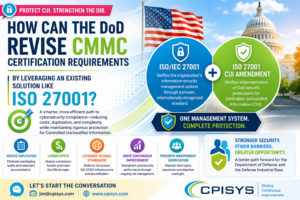
Introducing the Concept of an ISO 27001–CUI Amendment
Imagine a certification model that combines the strengths of both systems.
Organizations would first obtain accredited ISO/IEC 27001 certification, demonstrating that they have implemented an effective Information Security Management System.
They would then undergo a focused assessment against a DoD-defined CUI Amendment that verifies implementation of the additional technical and operational safeguards necessary to satisfy NIST SP 800-171 and any future CUI-specific requirements.
The result would be two complementary certifications:
- ISO/IEC 27001 Certification – Demonstrates that the organization operates an effective and continually improving Information Security Management System.
- ISO 27001–CUI Amendment Certification – Demonstrates that the organization has implemented and maintains the additional controls required to protect Controlled Unclassified Information.
Rather than maintaining multiple disconnected compliance programs, organizations would operate under a single management system with an additional defense-specific certification.
Why This Approach Makes Sense
- Reduce Duplicate Audits
Many organizations currently maintain compliance with multiple cybersecurity frameworks.
The same security controls are frequently documented, implemented, audited, and reported multiple times simply because different frameworks use different terminology.
By using ISO 27001 as the management system foundation, organizations could eliminate significant duplication while maintaining independent verification.
Resources currently spent preparing for multiple audits could instead be invested in strengthening cybersecurity.
- Lower Compliance Costs
Cost continues to be one of the greatest barriers preventing smaller organizations from entering or remaining within the Defense Industrial Base.
Duplicated documentation, consulting expenses, audit preparation, and recurring assessments all contribute to higher compliance costs.
Leveraging an internationally recognized certification already adopted by many organizations could substantially reduce those costs without reducing cybersecurity expectations.
For small manufacturers, engineering firms, software developers, and research organizations, that difference could determine whether pursuing defense contracts remains economically feasible.
- Build Upon Existing International Infrastructure
One of the greatest strengths of ISO certification is the mature conformity assessment infrastructure supporting it.
Today there are:
- Accredited Certification Bodies.
- National Accreditation Bodies.
- ISO/IEC 17021 accreditation requirements.
- ISO/IEC 27006 auditor competence requirements.
- Established surveillance audit processes.
- Consistent international oversight.
Rather than creating and maintaining a separate certification ecosystem, the Department of Defense could leverage decades of investment already made by industry.
- Encourage Continuous Improvement
Cybersecurity is not a one-time project.
New vulnerabilities emerge daily.
Attack methods continue to evolve.
Business technologies change continuously.
ISO 27001 was specifically designed around continual improvement.
Organizations are required to continually evaluate risk, update controls, measure effectiveness, conduct internal audits, and improve the overall management system.
That philosophy aligns exceptionally well with the long-term cybersecurity objectives of the Department of Defense.
- Preserve Independent Verification
Some may ask whether this approach reduces independent oversight.
Quite the opposite.
Certification would continue to be performed by accredited third-party certification bodies operating under internationally recognized accreditation requirements.
Independent verification remains.
Only the framework becomes more efficient.
Leveraging Existing C3PAOs
There is another opportunity that deserves consideration.
Today’s Cyber AB Authorized C3PAOs have already invested significant resources in becoming accredited inspection bodies under ISO/IEC 17020.
Those organizations have developed:
- Comprehensive quality management systems.
- Assessor qualification programs.
- Impartiality committees.
- Documented assessment methodologies.
- Technical competence programs.
- Internal quality assurance processes.
- Consistency review procedures.
That investment represents a tremendous national capability.
Rather than creating yet another independent certification workforce, the Department could explore how existing C3PAOs and accredited certification bodies might support an expanded certification model that incorporates ISO 27001 while continuing to verify CUI-specific protections.
Doing so would capitalize on expertise already developed within the defense cybersecurity community.
Benefits Across the Defense Industrial Base
An ISO 27001–CUI Amendment certification model could create meaningful benefits for every stakeholder.
Department of Defense
- Stronger focus on cybersecurity outcomes.
- Reduced administrative complexity.
- Better alignment with international standards.
- Increased scalability.
Prime Contractors
- Greater confidence throughout the supply chain.
- More consistent certification practices.
- Simplified supplier qualification.
Small Businesses
- Lower compliance costs.
- Reduced documentation burden.
- Increased competitiveness.
- Easier entry into defense contracting.
Certification Bodies
- Ability to leverage existing ISO certification expertise.
- More efficient auditing.
- Expanded market opportunities.
C3PAOs
- Opportunity to build upon existing assessment capability.
- Expanded role in defense cybersecurity certification.
- Continued independent verification of DoD-specific requirements.
A Practical Implementation Path
This concept would not require abandoning the work already completed under CMMC.
Instead, the Department could implement a phased transition:
- Define the CUI-specific requirements that extend beyond ISO 27001.
- Develop an official ISO 27001–CUI Amendment.
- Establish auditor qualification requirements.
- Recognize accredited certification bodies capable of delivering the certification.
- Leverage qualified C3PAOs where appropriate.
- Transition contractors over time through a phased adoption schedule.
This evolutionary approach minimizes disruption while preserving the Department’s investment in CMMC.
Looking Ahead
The cybersecurity threat landscape will continue to evolve.
Compliance programs must evolve as well.
Rather than asking organizations to comply with multiple independent cybersecurity frameworks, the Department of Defense has an opportunity to build upon a globally recognized management system while maintaining rigorous verification of defense-specific requirements.
Leveraging ISO/IEC 27001 through a dedicated CUI Amendment would reduce duplication, lower costs, improve consistency, and strengthen cybersecurity across the Defense Industrial Base.
Most importantly, it would allow organizations to focus less on managing multiple compliance programs and more on protecting the information that matters most.
Start the Conversation
At CPISYS, we believe the future of cybersecurity certification should combine internationally recognized best practices with the unique security requirements of the Department of Defense. We are actively exploring practical approaches that reduce unnecessary compliance burden while preserving independent, objective verification of CUI protections.
If you are a defense contractor, C3PAO, certification body, accreditation professional, or government stakeholder interested in discussing how an ISO/IEC 27001–CUI Amendment Certification could improve cybersecurity assurance and streamline compliance, we’d welcome the conversation.
Jim Goodrich
📧 jim@cpisys.com
Together, we can help shape a more efficient, scalable, and globally aligned cybersecurity certification model for the Defense Industrial Base.